
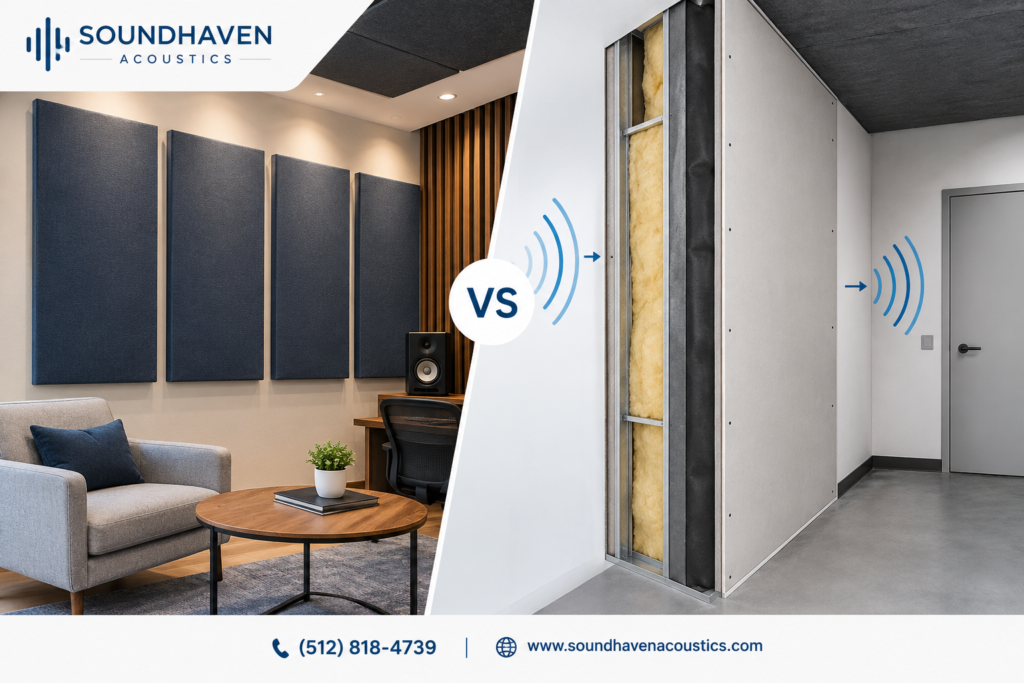
If you are trying to create a quieter, more comfortable space, you may have come across two terms: acoustic panels and soundproofing. While they are often used interchangeably, they solve two different sound problems.
Acoustic panels are primarily designed to absorb unwanted sound reflections, reduce echo, and improve sound clarity inside a room. Soundproofing focuses on reducing the amount of sound that enters or leaves a space.
Understanding the difference can help you choose the right solution for your home, office, studio, home theater, restaurant, school, or other commercial space.
What Are Acoustic Panels?
Acoustic panels are sound-absorbing products designed to control reflections and reverberation within a room. When sound waves hit hard surfaces such as drywall, glass, concrete, or wood, they can bounce around the space and create unwanted echo.
Acoustic panels absorb a portion of these sound waves, helping create a more controlled acoustic environment.
At SoundHaven Acoustics, our acoustic panels are designed to absorb unwanted reflections and reverberation while improving overall sound clarity. Our panels are suitable for a variety of environments, including studios, offices, home theaters, schools, restaurants, gyms, and other commercial spaces.
What Do Acoustic Panels Help With?
Acoustic panels can help:
- Reduce echo and reverberation
- Improve speech clarity
- Make conversations easier to understand
- Improve music and recording quality
- Reduce unwanted sound reflections
- Create a more comfortable acoustic environment
- Improve the overall listening experience
For example, an untreated conference room may have excessive echo that makes conversations difficult to follow. Strategically placed acoustic panels can absorb those reflections and make speech clearer.
What Is Soundproofing?
Soundproofing is different from acoustic treatment. Instead of primarily controlling reflections inside a room, soundproofing is intended to limit sound transmission between spaces.
A soundproofing system may involve structural changes or specialized building materials, such as:
- Additional wall mass
- Insulation
- Sound isolation systems
- Sealing gaps and air leaks
- Specialized barriers
- Decoupled wall or ceiling assemblies
- Improved doors and windows
The exact approach depends on where the unwanted sound is coming from and where it needs to be prevented from traveling.
For example, if you can hear conversations from an adjacent room, acoustic panels on your wall may reduce the sound reflections inside your room, but they will not completely stop the sound from passing through the wall.
Acoustic Panels vs. Soundproofing: The Key Difference
The simplest way to understand the difference is:
Acoustic panels improve how sound behaves inside a room, while soundproofing is designed to reduce sound transmission between spaces.
| Acoustic Panels | Soundproofing |
| Absorb sound reflections | Blocks or reduces sound transmission |
| Reduce echo and reverberation | Helps prevent sound from entering or leaving |
| Improve speech clarity | Improves sound isolation |
| Treat the acoustics inside a room | Often involves walls, ceilings, floors, doors, or windows |
| Usually easier to install | May require structural modifications |
| Ideal for studios, offices, theaters, restaurants, etc. | Ideal when noise needs to be contained or isolated |
Do Acoustic Panels Soundproof a Room?
No. Acoustic panels should not be considered a complete soundproofing solution.
Their primary purpose is sound absorption. They help control the sound that is already inside the room by reducing reflections and reverberation.
However, this can make a room feel significantly quieter and sound much clearer.
SoundHaven Acoustics focuses on acoustic treatment solutions designed to reduce unwanted reflections, reverberation, and low-frequency buildup while improving sound clarity.
If your primary problem is echo, poor speech clarity, or excessive reverberation, acoustic panels may be the right solution. If your goal is to stop noise from traveling through walls, a dedicated soundproofing strategy may be required.
When Should You Choose Acoustic Panels?
Acoustic panels are a good choice when the main problem is poor room acoustics.
You may benefit from acoustic treatment if you experience:
Excessive Echo
Hard surfaces can cause sound to bounce repeatedly around a room. Acoustic panels help absorb those reflections.
Poor Speech Clarity
In offices, classrooms, conference rooms, churches, and restaurants, excessive reverberation can make conversations difficult to understand.
Recording Problems
Studios and podcast rooms need controlled acoustics to produce more accurate recordings. Reflections from untreated walls can affect vocals, instruments, and recordings. SoundHaven Acoustics offers acoustic solutions for recording studios, podcast rooms, music production spaces, rehearsal rooms, and home studios.
Home Theater Sound Issues
Acoustic treatment can help reduce unwanted reflections and improve dialogue and overall listening clarity in home theaters.
Excessive Noise Inside Large Spaces
Gyms, restaurants, schools, and other large spaces can become uncomfortable when sound reflects from multiple hard surfaces. Proper acoustic treatment can help create a more controlled environment.
When Do You Need Soundproofing?
Soundproofing may be more appropriate when your primary concern is sound traveling between rooms or from outside.
Examples include:
- A home office next to a noisy room
- A recording studio near other occupied spaces
- Loud neighbors
- Traffic or exterior noise
- Machinery or equipment noise
- A room where music needs to be contained
- Shared walls between commercial spaces
In these situations, acoustic panels may still be useful, but they should be considered part of an overall acoustic strategy rather than a replacement for soundproofing.
Can You Use Acoustic Panels and Soundproofing Together?
Yes. In many projects, acoustic treatment and soundproofing can complement each other.
A soundproofing system can help reduce sound transmission through the building structure, while acoustic panels can control reflections and reverberation inside the treated room.
For example, a recording studio may require sound isolation to prevent music from traveling to neighboring rooms while also using acoustic panels to create an accurate listening and recording environment.
Using both approaches can address two different problems:
Soundproofing = control sound transmission
Acoustic treatment = control sound inside the room
Where Can Acoustic Panels Be Used?
Acoustic panels can be used in many residential and commercial environments.
SoundHaven Acoustics provides acoustic solutions for spaces including:
- Recording studios
- Home studios
- Offices
- Conference rooms
- Home theaters
- Schools
- Restaurants
- Gyms
- Churches
- Commercial spaces
The right treatment depends on the room’s size, surfaces, layout, purpose, and acoustic challenges.
Choosing the Right Acoustic Solution
Before purchasing acoustic products, consider what you actually want to accomplish.
1. Identify the Sound Problem
Ask yourself whether you are dealing with:
- Echo
- Reverberation
- Poor speech clarity
- Recording issues
- Sound traveling through walls
- Exterior noise
- Noise from neighboring rooms
This is the first step toward selecting the right solution.
2. Consider the Room
The size and construction of your room can affect acoustic performance. Rooms with large areas of glass, drywall, concrete, or other hard surfaces may require more sound absorption.
3. Consider Panel Placement
Acoustic panels are most effective when they are strategically positioned to address significant reflection areas rather than simply placed randomly around a room.
4. Consider Panel Thickness and Materials
Different acoustic products offer different levels of sound absorption. SoundHaven Acoustics offers standard wall panels with 2-inch and 4-inch thickness options, using Rockwool Acoustical Fire Batt insulation.
5. Consider Your Design
Acoustic treatment does not have to compromise the appearance of your space. SoundHaven Acoustics offers customizable finishes and designs intended to combine acoustic performance with a clean, professional appearance.
Why Choose SoundHaven Acoustics?
At SoundHaven Acoustics, we focus on creating sound-controlled environments that perform well while fitting naturally into the space.
Our acoustic panels are designed to help reduce unwanted reflections and reverberation while improving sound clarity. We provide solutions for residential, creative, and commercial environments, with standard and custom-sized acoustic panels available. Professional installation is also available for customers in the Austin, TX area.
Whether you are improving a home studio, conference room, home theater, restaurant, school, gym, or commercial facility, choosing the right acoustic treatment starts with understanding the difference between sound absorption and soundproofing.
Final Thoughts: Acoustic Panels vs. Soundproofing
Acoustic panels and soundproofing are not the same thing, but both can play an important role in creating a better sound environment.
Choose acoustic panels when your goal is to reduce echo, control reverberation, and improve sound clarity inside a room.
Consider soundproofing when your primary goal is to prevent sound from entering or leaving a space.
In some projects, using both approaches together may provide the best overall result.
If you’re unsure which solution your space needs, SoundHaven Acoustics can help you evaluate your acoustic requirements and identify an appropriate treatment approach.
Frequently Asked Questions
1. Are acoustic panels the same as soundproofing?
No. Acoustic panels primarily absorb sound reflections inside a room, while soundproofing is designed to reduce sound transmission between spaces.
2. Do acoustic panels block outside noise?
Acoustic panels are not designed to completely block outside noise. They primarily absorb sound within the room and reduce reflections and reverberation.
3. Do acoustic panels make a room quieter?
Yes, acoustic panels can make a room sound quieter and more comfortable by reducing reflected sound, echo, and reverberation. The amount of improvement depends on the room, panel specifications, quantity, and placement.
4. Can acoustic panels stop sound from going through walls?
Acoustic panels alone generally cannot stop sound from traveling through a wall. Reducing sound transmission usually requires a dedicated soundproofing approach involving the building structure.
5. Are acoustic panels good for home theaters?
Yes. Acoustic panels can help reduce unwanted reflections and improve dialogue and overall sound clarity in home theaters.
6. Are acoustic panels useful for recording studios?
Yes. Acoustic treatment is important in recording environments because excessive reflections can affect recordings and make it harder to accurately hear and mix audio. SoundHaven Acoustics provides acoustic solutions for studios, podcast rooms, and music production spaces.
7. Can acoustic panels and soundproofing be used together?
Yes. They address different acoustic problems and can complement each other. Soundproofing can reduce sound transmission, while acoustic panels can improve the sound quality inside the room.
8. How do I know whether I need acoustic panels or soundproofing?
Start by identifying the main problem. If you have echo, reverberation, or poor speech clarity, acoustic treatment may be appropriate. If noise is traveling through walls, ceilings, floors, doors, or windows, you may need a soundproofing strategy.
9. Does SoundHaven Acoustics offer custom acoustic panels?
Yes. SoundHaven Acoustics offers standard-size acoustic panels as well as custom-sized panels for unique spaces. Professional installation is also available in the Austin, TX area.
10. Where can I use SoundHaven Acoustics panels?
SoundHaven Acoustics provides acoustic solutions for studios, offices, gyms, home theaters, schools, restaurants, churches, and other residential and commercial spaces.