
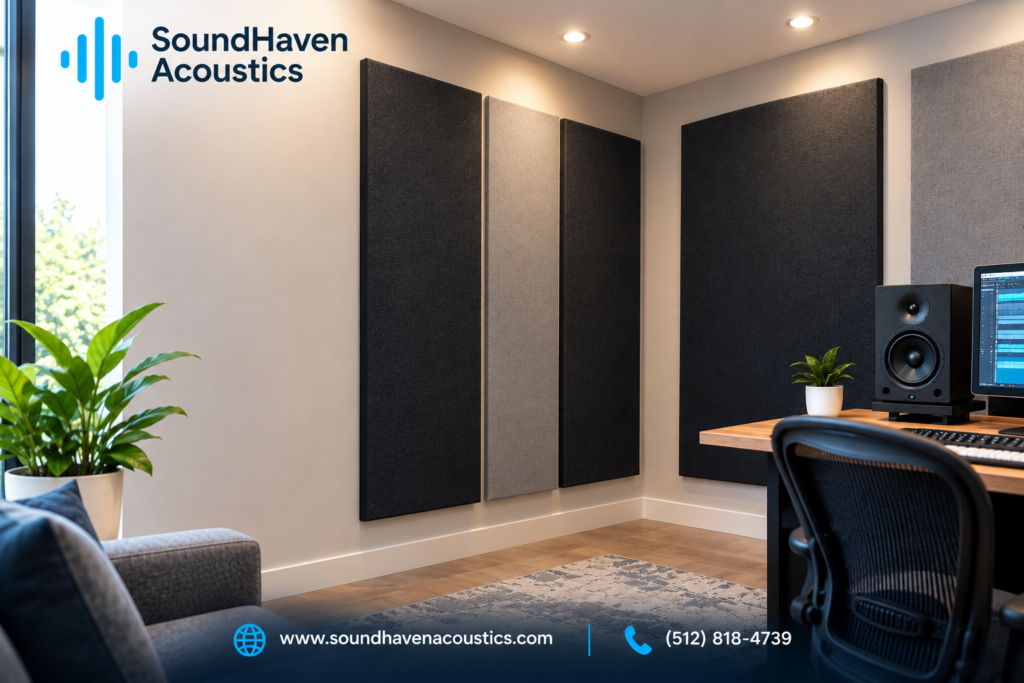
If your room sounds too boomy, muddy, or uneven, the problem may be low-frequency sound. Bass from speakers, subwoofers, drums, and other audio equipment can build up in certain areas of a room. This can make music and speech harder to hear clearly.
Bass trap panels are designed to help control these low-frequency problems. They can make a room sound more balanced, controlled, and comfortable.
What Are Bass Trap Panels?
Bass trap panels are acoustic treatment products designed to absorb or control low-frequency sound.
Low-frequency sound waves are longer than high-frequency waves. Because of this, they can be more difficult to control with thin acoustic panels.
Bass traps are usually thicker or specially designed to work with lower frequencies. They are often placed in room corners, where bass energy can build up.
They are commonly used in:
- Recording studios
- Home theaters
- Music rooms
- Home studios
- Listening rooms
- Podcast rooms
- Commercial audio spaces
Why Does Bass Build Up in a Room?
Sound waves reflect from walls, ceilings, and floors. Low-frequency waves can interact with each other and create areas where bass sounds much louder or quieter.
Room corners are especially important because sound can accumulate where two or more surfaces meet.
This can cause problems such as:
- Boomy bass
- Muddy music
- Excessive vibration
- Uneven sound levels
- Poor audio clarity
For example, you may hear strong bass in one part of a room but much less bass just a few feet away.
How Do Bass Trap Panels Work?
Bass traps help absorb some of the low-frequency energy that would otherwise continue reflecting around the room.
When sound enters the acoustic material, some of its energy is converted into a small amount of heat through friction within the material. This reduces the amount of sound energy that continues to reflect around the room.
The effectiveness of a bass trap depends on factors such as its thickness, design, placement, and the frequencies being treated.
Where Should Bass Trap Panels Be Installed?
Corners are usually the first place to consider when installing bass traps.
Common installation areas include:
- Vertical wall corners
- Wall-to-ceiling corners
- Wall-to-floor corners
- Other areas where bass buildup is noticeable
The right placement depends on the room’s size, shape, construction, and acoustic problems.
For a recording or listening room, it can be helpful to identify the areas with the strongest low-frequency buildup before deciding where to install additional treatment.
Bass Traps vs. Regular Acoustic Panels
Bass traps and regular acoustic panels serve different purposes.
Standard acoustic panels are commonly used to reduce mid- and high-frequency reflections. They can help improve speech clarity and reduce unwanted echoes.
Bass traps focus more on low-frequency problems.
In many rooms, using both types of acoustic treatment provides better results than relying on only one.
For example, wall-mounted acoustic panels can control reflections while bass traps help manage low-frequency buildup in corners.
Do You Need Bass Trap Panels?
Not every room needs the same amount of acoustic treatment.
Bass traps may be particularly useful if you notice:
- Booming or excessive bass
- Bass that changes significantly around the room
- Low-frequency ringing
- Difficulty getting accurate sound from speakers
- Muddy music or dialogue
They can be especially valuable in rooms used for music production, recording, mixing, and critical listening.
Benefits of Bass Trap Panels
Properly selected and positioned bass traps can provide several benefits.
Better Bass Control
Bass traps can help reduce excessive low-frequency energy and make bass sound more controlled.
Improved Audio Clarity
Controlling unwanted bass can make other parts of the audio easier to hear.
More Consistent Sound
Bass levels can vary significantly from one location to another. Acoustic treatment can help create a more balanced listening environment.
Better Mixing and Monitoring
For recording studios and home studios, uncontrolled bass can make it difficult to judge a mix accurately. Bass treatment can help create a more reliable monitoring environment.
A More Comfortable Room
Reducing excessive resonance can make a room feel less harsh, boomy, or acoustically overwhelming.
How Many Bass Traps Do You Need?
There is no single number that works for every room.
The number of bass traps depends on the room dimensions, construction, speakers, listening position, and the frequencies causing problems.
A small home studio may need a different treatment plan than a large recording studio or home theater.
Instead of simply adding as many panels as possible, it is better to consider the room’s specific acoustic needs.
Are Bass Traps Enough for Good Room Acoustics?
Bass traps are an important part of acoustic treatment, but they are not always enough by themselves.
A well-treated room may also need acoustic panels to control early reflections and other unwanted sound behavior.
The goal is to create a balanced room where low, mid, and high frequencies are appropriately controlled.
Frequently Asked Questions About Bass Trap Panels
What are bass trap panels used for?
Bass trap panels are used to control excessive low-frequency sound and reduce problems such as boomy or uneven bass.
Where should bass traps be placed?
Bass traps are commonly placed in room corners because low-frequency energy can build up in these areas.
Are bass traps the same as acoustic panels?
No. Standard acoustic panels generally focus on mid- and high-frequency reflections, while bass traps are designed to address low-frequency sound problems.
Do bass traps improve sound quality?
They can improve the balance and control of low frequencies, which may make music, speech, and other audio easier to hear clearly.
Do I need bass traps in a home studio?
If your home studio has noticeable bass buildup, uneven low frequencies, or difficulty producing accurate mixes, bass traps may be a useful part of your acoustic treatment.
Can bass traps be installed in corners?
Yes. Corners are one of the most common locations for bass traps because they are areas where low-frequency sound can accumulate.
Are thicker bass traps better?
Thickness can improve a bass trap’s ability to address lower frequencies, but performance also depends on the material, construction, placement, and design.
Final Thoughts
Bass can have a major impact on how a room sounds. When low-frequency energy builds up, music, speech, and other audio may sound boomy or unclear.
Bass trap panels can help control these problems by reducing unwanted low-frequency reflections and resonance. When combined with other acoustic treatments and installed correctly, they can help create a more balanced and controlled listening environment.
If you are planning acoustic treatment for a studio, home theater, music room, or other space, consider the room’s specific acoustic problems before choosing your bass traps.