
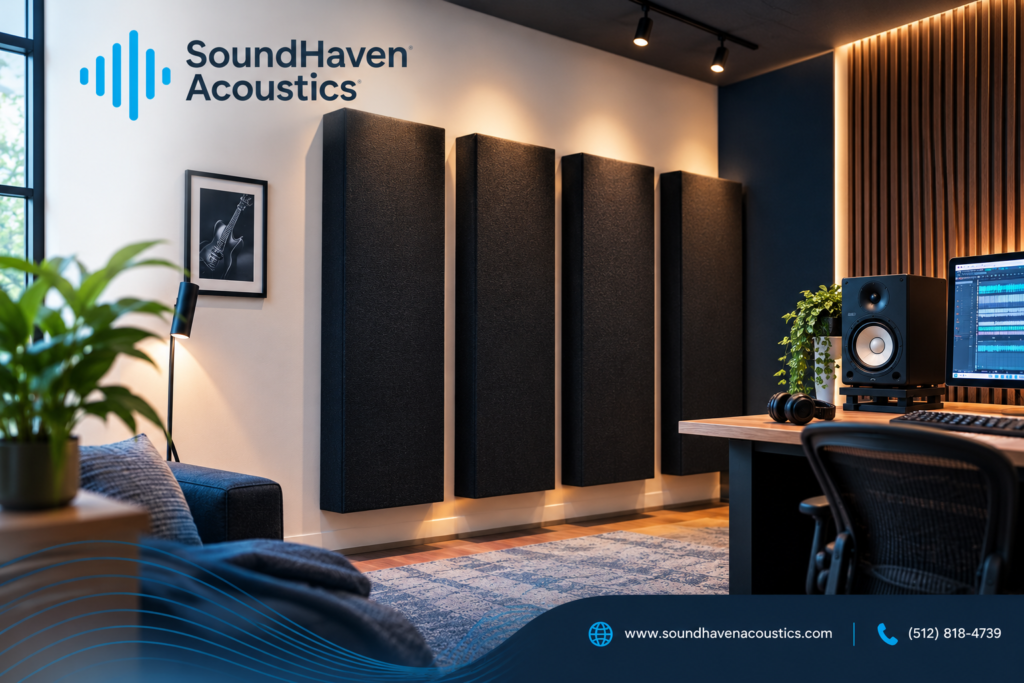
When a recording studio does not sound right, the first solution people often consider is adding acoustic panels to the walls. These panels can reduce unwanted reflections and improve sound clarity, but there is another important part of studio acoustics that is often overlooked: low frequency treatment.
Low frequencies from bass guitars, kick drums, subwoofers, and studio monitors can build up inside a room. When this happens, the studio may sound boomy or muddy, and it can become difficult to judge audio accurately.
This is where proper low frequency treatment and bass trap panels can make a difference.
What Is Low Frequency Treatment?
Low frequency treatment is the use of acoustic solutions designed to control deep bass and low-frequency energy inside a room.
Low-frequency sound waves are longer than higher-frequency waves. They can reflect from walls, ceilings, and floors and interact with one another. This can create areas where bass sounds too loud and other areas where it almost disappears.
The result is an uneven listening environment.
Bass traps are commonly used to help manage this type of low-frequency buildup. They can be an important part of an effective studio acoustic treatment plan.
Why Is Low Frequency Treatment Often Overlooked?
Many people start acoustic treatment by focusing on echoes and reflections.
Standard acoustic panels are useful for controlling mid and high frequencies. However, thinner panels may not provide enough control over deep bass.
This means a studio can have acoustic panels covering the walls and still have significant low-frequency problems.
The room may look professionally treated, but the bass response can remain uneven.
How Does Low Frequency Affect a Studio?
Uncontrolled bass can affect the way you record, monitor, and mix audio.
Some common signs include:
- Boomy or muddy bass
- Uneven bass levels around the room
- Kick drums that lack definition
- Bass notes that seem to disappear
- Low-frequency ringing
- Difficulty judging the amount of bass in a mix
- Different sound from your monitors depending on where you sit
These problems can make accurate mixing much harder.
What Causes Low Frequency Problems?
Several factors can contribute to low-frequency issues in a studio.
Room Size and Shape
The dimensions of a room affect how sound waves behave. Certain frequencies can resonate strongly depending on the room’s length, width, and height.
Speaker Placement
Studio monitors produce low-frequency energy that interacts with nearby walls and other surfaces. Poor speaker placement can contribute to an uneven bass response.
Room Corners
Corners are important areas for bass treatment because low-frequency energy can become concentrated where surfaces meet.
Lack of Proper Treatment
Without appropriate acoustic treatment, low-frequency reflections can continue to interact inside the room.
How Do Bass Trap Panels Work?
Bass trap panels are designed to absorb or control low-frequency sound energy.
They are often installed in corners because these areas can experience significant bass buildup.
Depending on their design and construction, bass traps can help reduce unwanted low-frequency reflections and resonance.
The goal is not to remove bass completely. Instead, the goal is to make the bass response more balanced and controlled.
Bass Traps vs. Regular Acoustic Panels
Bass traps and standard acoustic panels have different purposes.
Regular acoustic panels are generally used to control mid- and high-frequency reflections. They can help reduce unwanted echoes and improve speech and music clarity.
Bass traps are designed to provide greater control over low-frequency energy.
For many recording studios and home studios, using acoustic panels and bass traps together can provide a more balanced acoustic treatment solution.
Where Should Bass Traps Be Installed?
Bass traps are commonly installed in the corners of a room.
Depending on the room design and acoustic requirements, treatment may also be considered for:
- Vertical wall corners
- Wall-to-ceiling junctions
- Wall-to-floor areas
- Other locations where bass buildup is detected
There is no single placement strategy that works for every room. Room dimensions, speaker placement, listening position, and the type of bass problem should all be considered.
Why Low Frequency Treatment Matters for Mixing
Accurate monitoring is essential when mixing music.
Imagine your listening position has excessive bass. You may reduce the bass in your mix because it sounds too strong in the studio.
When you play that same mix somewhere else, it may sound too thin.
The opposite can also happen. If your listening position has a bass cancellation, you may add too much bass to compensate.
Better low-frequency control can help create a more predictable monitoring environment and make mixing decisions easier.
How Can You Tell if Your Studio Needs Bass Traps?
You may want to evaluate your studio’s low-frequency response if you notice:
- Bass sounds much louder in certain parts of the room
- Your mixes sound different outside the studio
- The kick drum lacks clarity
- Some bass notes are noticeably louder than others
- You hear a strong low-frequency boom
- Bass changes significantly when you move around the room
These signs can have different causes, so proper room evaluation is useful before selecting acoustic treatment.
Are Bass Traps Enough for Studio Acoustic Treatment?
Bass traps are important, but they are not always the only treatment a studio needs.
A complete studio acoustic treatment plan may also address:
- Early reflections
- Mid-frequency reflections
- High-frequency reflections
- Room resonance
- Speaker placement
- Listening position
The goal is to create a balanced acoustic environment rather than simply adding as many panels as possible.
Choosing Acoustic Treatment for Your Studio
Every studio has different acoustic requirements.
Before purchasing acoustic products, consider:
Room Dimensions
Measure the length, width, and height of the room. These measurements can help identify potential room-mode problems.
Listening Position
Where you sit relative to the walls can have a significant effect on the bass you hear.
Speaker Setup
Monitor placement can affect low-frequency response, so speakers should be positioned carefully.
Type of Acoustic Treatment
A combination of bass trap panels, acoustic panels, and other acoustic treatment solutions may be appropriate depending on the room.
Why Choose SoundHaven Acoustics?
SoundHaven Acoustics provides acoustic treatment solutions for spaces where sound quality and room control matter.
Whether you are improving a home recording studio, music room, listening space, or professional studio, the right acoustic treatment can help address unwanted reflections and low-frequency problems.
Instead of treating only the most visible acoustic issues, consider the full frequency range of your room.
Frequently Asked Questions
What is low frequency treatment?
Low frequency treatment is the use of acoustic solutions to control deep bass and unwanted low-frequency energy inside a room.
Why is low frequency treatment important in a studio?
It can help control uneven bass, excessive resonance, and other low-frequency problems that can affect recording and mixing.
Are bass traps the same as acoustic panels?
Not exactly. Standard acoustic panels are generally designed to control mid and high frequencies, while bass traps are designed to provide more control over low-frequency energy.
Where should bass trap panels be placed?
Bass trap panels are commonly installed in room corners, where low-frequency energy can build up. The ideal placement depends on the room and its acoustic characteristics.
Do I need bass traps in a home studio?
If your studio has noticeable bass buildup, uneven bass response, or difficulty producing accurate mixes, bass traps may be a useful part of your acoustic treatment.
Can regular acoustic panels fix bass problems?
Regular acoustic panels can help with reflections, but thin panels may not provide enough low-frequency absorption. Bass traps or other low-frequency treatment may be needed for deeper bass problems.
Do bass traps soundproof a studio?
No. Bass traps are designed primarily for acoustic treatment, not soundproofing. Soundproofing focuses on reducing sound transmission between spaces, while acoustic treatment improves the sound inside a room.
How many bass traps does a studio need?
There is no fixed number. The amount of treatment depends on the room’s dimensions, construction, speaker setup, listening position, and acoustic problems.
Improve Your Studio’s Low-Frequency Response
Low-frequency problems can be easy to overlook, but they can have a major effect on how a studio sounds.
If your room has boomy bass, uneven low frequencies, or inconsistent monitoring, low frequency treatment may be the missing part of your acoustic treatment plan.
SoundHaven Acoustics offers acoustic treatment solutions to help you create a more balanced and controlled space.
Explore bass trap panels and acoustic treatment solutions, or contact SoundHaven Acoustics to discuss the right solution for your studio.