
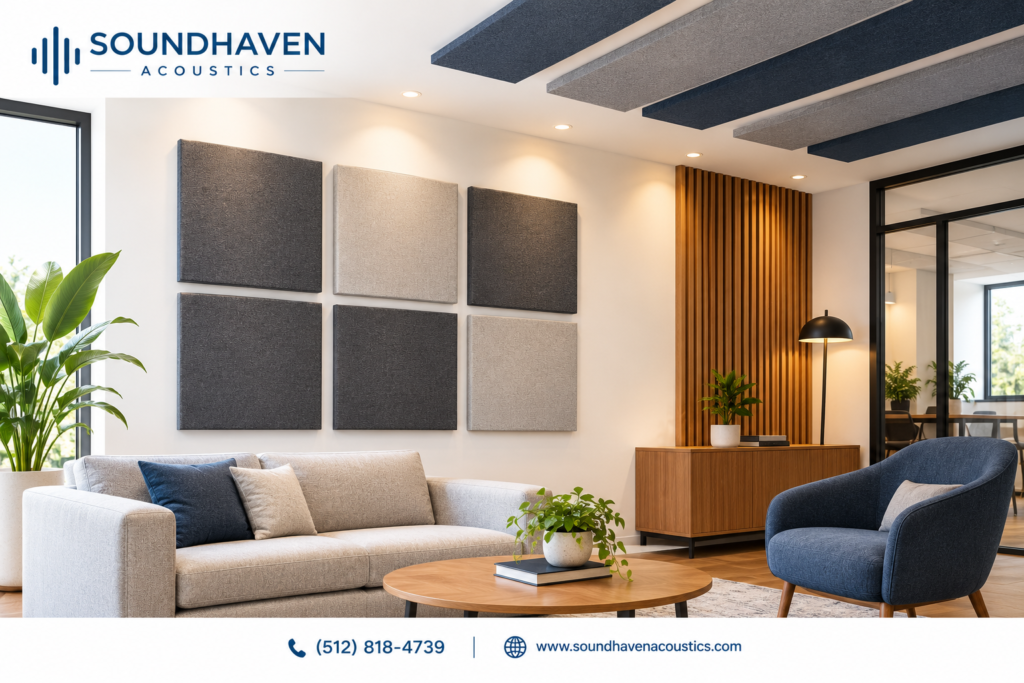
Choosing the right acoustic panels can make a noticeable difference in how a room sounds. Whether you are setting up a home studio, improving speech clarity in an office, creating a better home theater experience, or managing noise in a commercial space, the right acoustic treatment can help control unwanted reflections and reverberation.
However, not every acoustic panel is the same. Panel thickness, size, materials, placement, fabric, and the purpose of the room all play an important role in determining the right solution.
This complete buyer’s guide explains what acoustic panels are, how they work, what to look for when purchasing them, and how to choose the right acoustic treatment for your space.
What Are Acoustic Panels?
Acoustic panels are sound-absorbing products designed to reduce unwanted sound reflections and reverberation inside a room.
When sound waves hit hard surfaces such as drywall, glass, concrete, wood, or tile, they can bounce around the room. Too many reflections can create echo, reduce speech clarity, and make music or other audio sound less controlled.
Acoustic panels absorb a portion of these sound waves, helping create a more balanced and comfortable acoustic environment.
At SoundHaven Acoustics, acoustic panels are designed to absorb unwanted reflections, reverberation, and low-frequency resonances while improving sound clarity. The company offers acoustic solutions for studios, offices, home theaters, conference rooms, schools, commercial spaces, and other environments.
How Do Acoustic Panels Work?
Acoustic panels work by absorbing sound energy rather than allowing sound waves to continue reflecting from hard surfaces.
A typical room with many hard surfaces can produce multiple reflections. These reflections overlap with the original sound, which can make speech difficult to understand and audio less clear.
Strategically placed acoustic panels help reduce these reflections and shorten reverberation within the room.
The result can include:
- Less echo
- Better speech intelligibility
- Improved music clarity
- Reduced reverberation
- A more controlled listening environment
- Greater acoustic comfort
The goal is not necessarily to make a room completely silent. Instead, acoustic treatment helps the room sound better.
What Should You Look for When Buying Acoustic Panels?
Several factors should be considered before choosing acoustic panels.
1. Panel Thickness
Thickness can affect the amount and range of sound absorption a panel provides.
Thicker panels can be particularly useful when greater absorption is required. SoundHaven Acoustics offers acoustic wall panels with 2-inch and 4-inch thickness options, allowing customers to select a configuration based on their acoustic requirements.
2. Panel Size
The size and number of panels you need depend on the dimensions and acoustic characteristics of the room.
SoundHaven Acoustics’ standard acoustic wall panels are available in 2′ × 2′ and 2′ × 4′ sizes.
Larger panels can cover more wall area, while smaller panels can provide greater flexibility when designing a treatment layout.
3. Absorption Material
The internal material plays an important role in acoustic performance.
SoundHaven Acoustics’ standard acoustic wall panels use Rockwool Acoustical Fire Batt insulation and are constructed with a wood back for stability.
When comparing acoustic panels, look beyond appearance and consider the materials used to achieve sound absorption.
4. Fabric and Finish
Acoustic panels are often visible elements within a room, so appearance matters as well as performance.
SoundHaven Acoustics offers a wide range of fabric and color options, making it possible to coordinate acoustic treatment with the design of the room.
This can be particularly useful for offices, restaurants, home theaters, studios, and other spaces where acoustic treatment needs to complement the existing interior.
5. Edge Profile
The edge design can affect the appearance of an acoustic panel.
SoundHaven Acoustics standard panels are available with a square edge or 1/2-inch beveled edge.
The right choice depends on the look you want to achieve and how the panels will be arranged.
6. Mounting System
Installation should also be considered when purchasing acoustic panels.
SoundHaven Acoustics’ standard wall panels include 2-inch Z-clips and fasteners for secure wall mounting.
A suitable mounting system makes installation more straightforward and helps ensure the panels remain securely positioned.
How Many Acoustic Panels Do You Need?
There is no single number of acoustic panels that works for every room.
The amount required depends on factors such as:
- Room size
- Ceiling height
- Wall and ceiling materials
- Amount of glass or other reflective surfaces
- Room purpose
- Existing furniture
- Desired level of acoustic control
- Panel thickness and performance
A small home office may require significantly less treatment than a large gym, restaurant, school, or commercial facility.
Rather than covering every available surface, acoustic panels should generally be placed strategically in areas where sound reflections are creating the greatest problems.
For larger or more complex projects, professional guidance can help determine the appropriate treatment approach.
Where Should Acoustic Panels Be Installed?
Panel placement is just as important as panel selection.
Common installation areas include:
Walls
Wall-mounted acoustic panels can help control reflections between parallel surfaces and improve overall sound clarity.
First Reflection Points
In listening rooms, studios, and home theaters, first reflection points can be important areas for acoustic treatment.
Ceilings
Ceiling-mounted acoustic panels can be useful when wall space is limited or when reflections from the ceiling contribute to excessive reverberation.
Corners
Corners can be important areas for managing low-frequency buildup. Specialized solutions such as corner bass traps may be appropriate depending on the room.
SoundHaven Acoustics offers wall panels, ceiling panels, and corner bass traps as part of its acoustic treatment solutions.
Acoustic Panels for Different Spaces
The best acoustic solution depends on how the room is being used.
Acoustic Panels for Recording Studios
Recording studios require controlled acoustics for recording, monitoring, and mixing.
Acoustic panels can help reduce unwanted reflections and reverberation, creating a more controlled listening environment.
Acoustic Panels for Home Studios and Podcast Rooms
Home studios and podcast spaces often have hard walls and limited room for acoustic treatment.
Strategically placed acoustic panels can help improve voice clarity and reduce unwanted room reflections.
Acoustic Panels for Offices and Conference Rooms
Excessive reverberation can make conversations and meetings difficult to follow.
Acoustic treatment can help improve speech clarity and create a more comfortable environment for employees and visitors.
Acoustic Panels for Home Theaters
Home theaters benefit from controlled room acoustics because unwanted reflections can affect dialogue, music, and overall listening quality.
Acoustic panels can help create a more controlled sound environment.
Acoustic Panels for Schools
Classrooms and educational spaces need good speech intelligibility so students can clearly hear teachers and participate in discussions.
Acoustic treatment can help reduce excessive reverberation and improve communication.
Acoustic Panels for Restaurants
Restaurants can become noisy when conversations, music, kitchen activity, and other sounds reflect from hard surfaces.
Acoustic panels can help control reverberation and create a more comfortable dining environment.
Acoustic Panels for Gyms
Gyms often contain large open areas and hard surfaces that can amplify sound.
Acoustic treatment can help reduce excessive echo and create a more comfortable environment for members and staff.
Acoustic Panels for Churches
Large worship spaces can experience significant reverberation because of their size and construction.
Proper acoustic treatment can help improve speech intelligibility and overall sound clarity.
SoundHaven Acoustics specifically lists studios, offices, gyms, home theaters, schools, restaurants, and churches among its application areas.
Wall Panels vs. Ceiling Panels
Both wall and ceiling acoustic panels can play an important role in room treatment.
Wall panels are useful when wall reflections are a primary concern and can also be incorporated into the interior design.
Ceiling panels can provide additional sound absorption when wall space is limited or when ceiling reflections contribute to reverberation.
The best option depends on the room’s construction, layout, and acoustic requirements.
Do You Need Bass Traps?
In some rooms, particularly studios and dedicated listening environments, low-frequency energy can accumulate in corners and create uneven bass response.
Corner bass traps are designed to address low-frequency acoustic problems.
They can be particularly useful in rooms where bass sounds appear excessively strong or inconsistent depending on where you are standing or sitting.
SoundHaven Acoustics offers corner bass traps as part of its acoustic treatment product range.
Custom Acoustic Panels vs. Standard Panels
Standard acoustic panels can be a practical option for many rooms, particularly when common panel sizes fit the available wall space.
However, some projects have unique dimensions, design requirements, or acoustic challenges.
Custom acoustic treatment may be useful when you need:
- Specific panel dimensions
- A particular fabric or color
- A unique layout
- Treatment for an unusual wall configuration
- A coordinated design throughout a commercial space
SoundHaven Acoustics provides guidance and tailored solutions for residential and commercial projects and invites customers to contact the team regarding custom projects.
Common Acoustic Panel Buying Mistakes
Before purchasing acoustic panels, avoid these common mistakes.
Choosing Panels Based Only on Appearance
A panel may look attractive but still be unsuitable for your acoustic requirements.
Consider the material, thickness, size, and intended application.
Assuming Acoustic Panels Are Soundproofing
Acoustic panels control sound inside a room. They are not a complete replacement for structural soundproofing.
Installing Too Few Panels
Adding a small number of panels may not provide enough absorption for a large or highly reflective room.
Ignoring Placement
Simply installing panels wherever there is available wall space may not provide the best result.
Placement should consider where sound reflections occur.
Treating Every Room the Same
A podcast room, conference room, restaurant, and recording studio have different acoustic requirements.
The treatment should match the purpose of the space.
Focusing Only on Walls
Ceilings, corners, floors, windows, doors, and furniture can all influence room acoustics.
A complete acoustic assessment should consider the room as a whole.
Why Choose SoundHaven Acoustics?
SoundHaven Acoustics focuses on creating sound-controlled environments that combine acoustic performance with clean, customizable design.
The company uses industry-standard sound absorption materials and offers professional-grade acoustic panels designed to reduce unwanted reflections and reverberation. SoundHaven Acoustics also provides tailored acoustic solutions for both residential and commercial environments.
Its standard acoustic wall panels are available in multiple sizes, thicknesses, edge profiles, fabrics, and colors, giving customers flexibility when selecting a solution for their space.
Whether you are treating a home studio, conference room, home theater, school, restaurant, gym, church, or commercial facility, choosing the right acoustic treatment starts with understanding your room and its specific sound challenges.
Final Acoustic Panel Buying Checklist
Before purchasing acoustic panels, consider the following:
- What is the main acoustic problem?
- Is the goal sound absorption or soundproofing?
- How large is the room?
- How reflective are the walls and ceiling?
- What panel thickness is appropriate?
- What panel size will work best?
- What material is used inside the panel?
- Where should the panels be installed?
- Do you need wall or ceiling treatment?
- Would corner bass traps be beneficial?
- What fabric and finish fit your space?
- Do you need standard or custom-sized panels?
- Will professional installation be required?
Taking the time to answer these questions can help you choose acoustic panels that are better suited to your room and intended use.
Frequently Asked Questions About Acoustic Panels
Are acoustic panels worth it?
Yes. Acoustic panels can be a valuable solution when a room suffers from excessive echo, reverberation, or poor sound clarity. The effectiveness depends on factors such as the room, panel specifications, quantity, and placement.
Do acoustic panels make a room soundproof?
No. Acoustic panels primarily absorb sound reflections inside a room. They should not be considered a complete soundproofing solution for preventing sound from entering or leaving a space.
How thick should acoustic panels be?
The appropriate thickness depends on the room and the acoustic problem being addressed. SoundHaven Acoustics offers standard acoustic wall panels in 2-inch and 4-inch thickness options.
How many acoustic panels do I need for a room?
There is no universal number. Room size, surface materials, room purpose, existing furnishings, and the level of acoustic control required all influence how many panels may be appropriate.
Where is the best place to put acoustic panels?
The best placement depends on the room. Panels are commonly positioned on walls at significant reflection points, while ceiling panels and corner treatments may be used when appropriate.
Are acoustic panels good for home theaters?
Yes. Acoustic panels can help reduce unwanted reflections and reverberation, which can improve the clarity and overall listening experience in a home theater.
Can acoustic panels help with speech clarity?
Yes. By reducing excessive reflections and reverberation, acoustic panels can make spoken communication easier to understand in offices, classrooms, conference rooms, churches, and other spaces.
What materials are used in SoundHaven Acoustics acoustic panels?
SoundHaven Acoustics’ standard acoustic wall panels use Rockwool Acoustical Fire Batt insulation and a wood back for stability.
Does SoundHaven Acoustics offer different panel sizes?
Yes. Standard acoustic wall panels are available in 2′ × 2′ and 2′ × 4′ sizes, with 2-inch and 4-inch thickness options.
Can I customize the appearance of acoustic panels?
Yes. SoundHaven Acoustics’ standard panels offer multiple fabric, color, and edge-profile options, allowing the panels to complement different interior designs.
Does SoundHaven Acoustics provide acoustic solutions for commercial spaces?
Yes. SoundHaven Acoustics provides acoustic solutions for a range of commercial and professional environments, including offices, schools, restaurants, gyms, churches, studios, and other spaces.
Improve Your Space with SoundHaven Acoustics
The right acoustic panels can transform the way a room sounds while complementing its overall design. From reducing echo in a conference room to improving sound clarity in a home studio or home theater, acoustic treatment can make a meaningful difference.
SoundHaven Acoustics provides professional-grade acoustic solutions designed around real-world acoustic challenges. Explore the available acoustic panels and contact the SoundHaven Acoustics team to discuss the right solution for your space.