
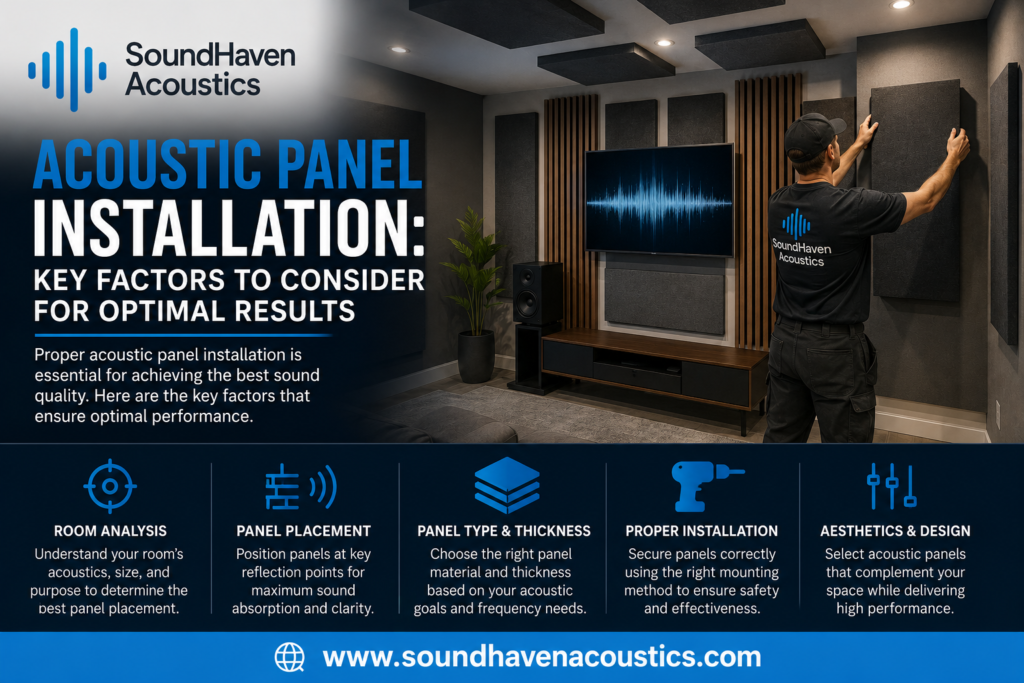
Whether you’re designing a home theater, recording studio, office, conference room, or entertainment space, sound quality plays a major role in the overall experience. Many people invest in premium audio equipment but overlook one of the most important elements of acoustic performance: proper room treatment. Even the highest-quality speakers can struggle in a room with excessive echoes and sound reflections.
This is why Acoustic Panel Installation is essential for creating a balanced and comfortable listening environment. However, simply mounting panels on a wall isn’t enough. To achieve the best results, several factors must be considered during the planning and installation process.
AtSoundHaven Acoustics, we help homeowners, businesses, and audio professionals optimize their spaces with customized acoustic solutions designed to improve sound quality and reduce unwanted noise.
Why Acoustic Panel Installation Matters
Sound behaves differently in every room. Hard surfaces such as drywall, glass, concrete, and hardwood floors reflect sound waves, causing echoes, reverberation, and uneven audio distribution.
Professional Acoustic Panel Installation helps:
- Improve speech clarity
- Reduce echoes and reverberation
- Enhance music and audio quality
- Increase comfort in shared spaces
- Create a more controlled acoustic environment
Without proper treatment, even expensive sound systems may fail to perform at their full potential.
Understanding Your Room’s Purpose
Before beginning any Acoustic Panel Installation, it’s important to determine how the space will be used.
Different environments have unique acoustic requirements.
Home Theaters
Focus on improving dialogue clarity and surround sound performance.
Recording Studios
Require precise sound control and accurate monitoring conditions.
Offices and Conference Rooms
Prioritize speech intelligibility and noise reduction.
Restaurants and Commercial Spaces
Aim to reduce background noise and improve customer comfort.
Understanding the room’s function helps guide the acoustic treatment strategy.
Identifying Reflection Points
One of the most critical aspects of Acoustic Panel Installation is identifying where sound reflections occur.
Sound waves bounce off surfaces before reaching the listener, which can create:
- Echoes
- Phase issues
- Blurred audio
- Reduced clarity
Common reflection areas include:
- Side walls
- Rear walls
- Ceilings
- Large windows
- Hard flooring surfaces
Treating these key reflection points often delivers the greatest improvement in sound quality.
Choosing the Right Acoustic Panels
Not all acoustic panels are created equal.
Successful Acoustic Panel Installation depends on selecting panels that match the room’s needs.
Factors to consider include:
Panel Thickness
Thicker panels generally absorb a wider range of frequencies, including lower frequencies.
Material Quality
High-density acoustic materials typically provide better sound absorption.
Panel Size
Larger panels can cover more reflective surfaces and improve overall effectiveness.
Aesthetic Design
Modern acoustic panels come in various colors, fabrics, and custom designs that complement interior décor.
Choosing the right panel type ensures maximum performance and visual appeal.
Proper Panel Placement Is Essential
Many people assume that simply adding more panels will automatically improve acoustics. In reality, placement is often more important than quantity.
Effective Acoustic Panel Installation focuses on:
- First reflection points
- Listening positions
- Speaker locations
- Ceiling reflections
- Rear-wall sound management
Strategic placement creates a balanced acoustic environment without over-treating the room.
Balancing Absorption and Natural Sound
A common mistake during Acoustic Panel Installation is using too many panels.
While absorption is important, excessive treatment can make a room sound:
- Flat
- Lifeless
- Unnatural
The goal is to reduce unwanted reflections while maintaining a natural sense of space and ambiance.
Professional acoustic design helps achieve the right balance between sound control and room liveliness.
Considering Ceiling Acoustics
Ceilings are often overlooked during Acoustic Panel Installation, yet they can significantly affect sound quality.
Ceiling reflections can contribute to:
- Echoes
- Reduced speech clarity
- Blurred audio imaging
Acoustic ceiling panels or suspended acoustic treatments can dramatically improve overall room performance, particularly in home theaters, studios, and commercial spaces.
Addressing Low-Frequency Issues
While standard acoustic panels absorb mid- and high-frequency sounds, low frequencies often require specialized treatment.
Bass buildup can cause:
- Boomy sound
- Uneven bass response
- Listening fatigue
For optimal Acoustic Panel Installation, bass traps may be recommended in corners where low-frequency energy tends to accumulate.
Combining acoustic panels with bass management solutions often produces the best overall results.
Room Size and Layout Considerations
Every room presents unique acoustic challenges.
Factors that influence Acoustic Panel Installation include:
- Room dimensions
- Ceiling height
- Furniture placement
- Flooring materials
- Window locations
A customized acoustic strategy ensures treatments are tailored to the specific characteristics of the space.
Professional Acoustic Assessment
While DIY installations can improve sound quality, professional evaluation often delivers superior results.
Experienced acoustic specialists analyze:
- Reflection patterns
- Reverberation times
- Speaker placement
- Room geometry
- Acoustic goals
Professional Acoustic Panel Installation ensures treatments are positioned for maximum effectiveness and long-term performance.
Benefits of Professional Acoustic Panel Installation
Working with experts provides several advantages:
Improved Audio Quality
Clearer sound and more accurate audio reproduction.
Better Speech Intelligibility
Easier communication in offices, conference rooms, and public spaces.
Enhanced Home Entertainment
More immersive movies, music, and gaming experiences.
Increased Comfort
Reduced noise-related stress and listening fatigue.
Attractive Design Integration
Panels that complement the room’s aesthetic while delivering acoustic benefits.
Additional Services Available from SoundHaven Acoustics
Beyond Acoustic Panel Installation, SoundHaven Acoustics offers a variety of sound management solutions.
Acoustic Panels for Home Theater
Customized treatments designed to improve cinematic audio performance.
Recording Studio Acoustic Design
Precision acoustic treatments for content creators and musicians.
Commercial Acoustic Solutions
Noise management systems for businesses and public environments.
Residential Sound Control
Acoustic improvements for media rooms, living spaces, and multi-purpose rooms.
These services help clients achieve superior sound quality across a wide range of environments.
Signs You Need Acoustic Panel Installation
You may benefit from Acoustic Panel Installation if you notice:
- Excessive echo
- Difficulty understanding conversations
- Poor audio clarity
- Uneven sound distribution
- Harsh listening environments
- Distracting background noise
These issues often indicate that room acoustics are negatively affecting sound performance.
Final Thoughts
Effective Acoustic Panel Installation is about much more than adding panels to a wall. Proper planning, strategic placement, material selection, and room analysis all contribute to achieving optimal acoustic performance.
Whether you’re improving a home theater, recording studio, office, or commercial space, professional acoustic treatment can dramatically enhance sound quality, comfort, and overall user experience.
At SoundHaven Acoustics, we specialize in customized acoustic solutions that help clients create environments where sound performs at its absolute best.
Frequently Asked Questions
1. What is Acoustic Panel Installation?
Acoustic Panel Installation involves placing sound-absorbing panels in strategic locations to reduce echoes, improve clarity, and enhance overall room acoustics.
2. Where should acoustic panels be installed?
Panels are typically installed on walls, ceilings, and reflection points where sound waves bounce most frequently.
3. How many acoustic panels does a room need?
The number depends on room size, purpose, and acoustic challenges. A professional assessment can determine the ideal quantity and placement.
4. Do acoustic panels eliminate all noise?
No. Acoustic panels primarily control sound reflections within a room. Additional treatments may be needed for soundproofing and external noise reduction.
5. Is professional Acoustic Panel Installation worth it?
Yes. Professional installation helps ensure optimal placement, balanced acoustics, and maximum performance based on your room’s specific characteristics.