
When researching acoustic treatment, one recommendation shows up again and again:
“Place your bass traps in corners.”
But why corners?
Is it really because bass “builds up” there—or is there a deeper acoustic reason?
In this guide, we’ll break down why bass traps in corners are so effective, how low frequencies behave in a room, and how proper placement can dramatically improve clarity, balance, and low-end control.
Why Low Frequencies Are the Hardest to Control
Bass frequencies behave very differently from mid and high frequencies. Their long wavelengths allow them to:
- Travel farther
- Reflect more aggressively
- Linger longer in a room
These reflections create standing waves (room modes), which cause uneven bass—some notes boom, others disappear entirely. This is the root of muddy mixes, unclear dialogue, and inaccurate listening environments.
That’s where bass traps come in.
What Are Bass Traps in Corners?
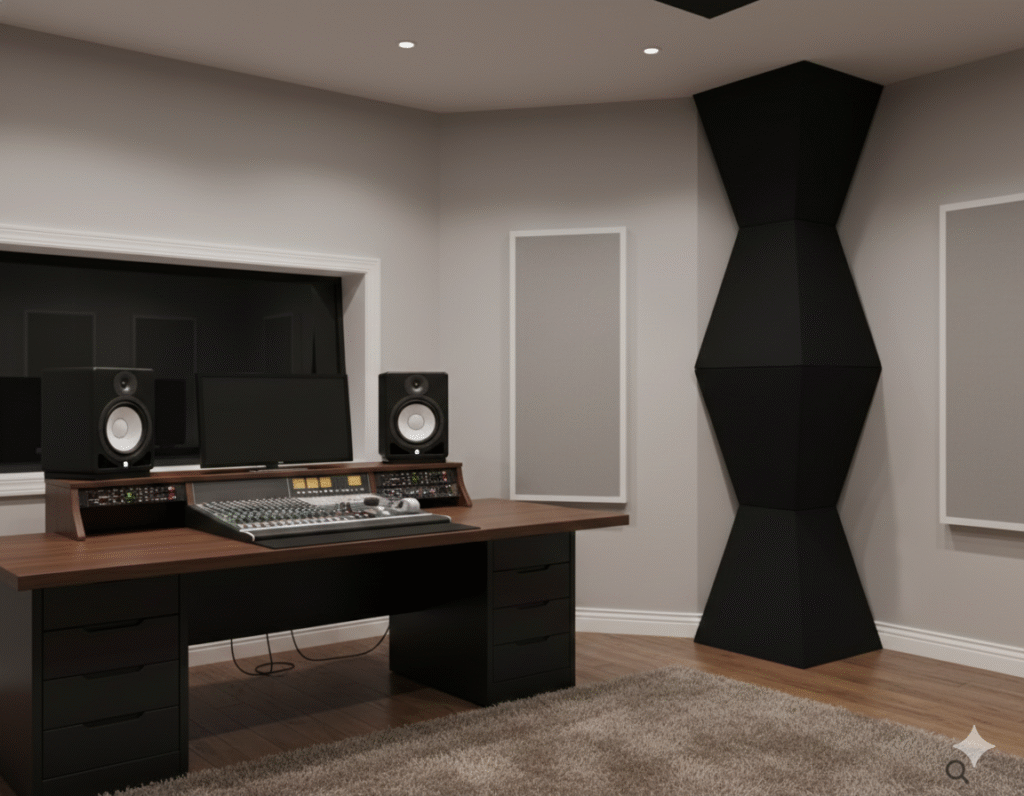
Bass traps in corners are acoustic absorbers placed where walls meet—either vertically (wall-to-wall) or horizontally (wall-to-ceiling).
Most modern bass traps use porous materials like mineral wool or fiberglass, which absorb sound by slowing down moving air particles and converting that energy into heat.
Unlike thin wall panels, bass traps are thicker and strategically placed to target low-frequency problems at their source.
The Real Acoustic Reason Bass Traps Go in Corners
It’s often said that bass traps belong in corners because “bass builds up there.”
While this sounds logical, it’s only part of the story.
Pressure vs. Velocity: The Key Concept
Sound waves have two main components:
- Sound pressure
- Air particle velocity
In a standing wave:
- Sound pressure is highest at boundaries (walls and corners)
- Air particle velocity is lowest at those same points
Porous bass traps work best where air particle velocity is highest, not where pressure is highest.
So why place bass traps in corners at all?
The 1/4 Wavelength Rule Explained
Here’s the real reason bass traps in corners are so effective:
Porous absorbers perform best when placed away from the wall, ideally near the ¼ wavelength point of the frequency being absorbed.
Low frequencies require a lot of space to reach this point—and placing panels flat on walls simply doesn’t provide enough depth.
Corners Solve This Problem
When a bass trap is mounted across a corner, it:
- Creates a large air gap behind the panel
- Increases effective absorption depth
- Allows the trap to interact with lower frequencies
- Maximizes absorption without wasting floor space
In other words, corners allow bass traps to work on deeper bass frequencies efficiently.
Why Corner Placement Beats Flat Wall Mounting
Placing a bass trap flat against a wall limits its low-frequency performance.
Placing it across a corner:
- Increases air particle movement through the absorber
- Improves absorption at lower frequencies
- Enhances broadband performance
- Uses room geometry to your advantage
That’s why bass traps in corners consistently outperform wall-mounted traps for low-end control.
Vertical vs. Horizontal Corners
Both corner types matter:
Vertical Corners (Wall-to-Wall)
- Primary priority
- Strongest low-frequency interaction
- Ideal starting point for any room
Horizontal Corners (Wall-to-Ceiling)
- Often overlooked
- Excellent for additional bass smoothing
- Great for small or rectangular rooms
Treating both types leads to more even bass response across the room.
What About Different Types of Bass Traps?
Porous Bass Traps
Best for:
- Broadband absorption
- Home studios
- Home theaters
- General room treatment
These traps benefit most from corner placement and air gaps.
Resonant Bass Traps
Designed to:
- Target specific problem frequencies
- Work on pressure, not velocity
These must be placed precisely and are typically used after broadband corner bass traps are installed.
For most rooms, porous bass traps in corners deliver the biggest improvement with the least complexity.
How Many Bass Traps Should You Put in Corners?
A solid starting point:
- At least four vertical corner bass traps
- More for larger rooms or serious listening spaces
Acoustic performance improves with coverage. The more corner surface area you treat, the smoother and tighter your bass response becomes.
Are Bass Traps in Corners Only for Studios?
Not at all.
They are ideal for:
- Home studios
- Home theaters
- Podcast rooms
- Music rehearsal spaces
- Conference rooms
- Listening rooms
Any space where clarity, balance, and comfort matter will benefit.
The Bottom Line: Why Bass Traps in Corners Matter
Bass traps aren’t just accessories—they’re foundational.
Placing bass traps in corners:
- Maximizes low-frequency absorption
- Reduces standing waves
- Improves clarity and translation
- Makes your room sound controlled, balanced, and accurate
At SoundHaven Acoustics, we design professional-grade bass traps and corner solutions that blend performance with clean aesthetics—so your space sounds as good as it looks.
Ready to Upgrade Your Room Sound?
Explore our corner bass traps or contact our team for expert acoustic guidance tailored to your space.