
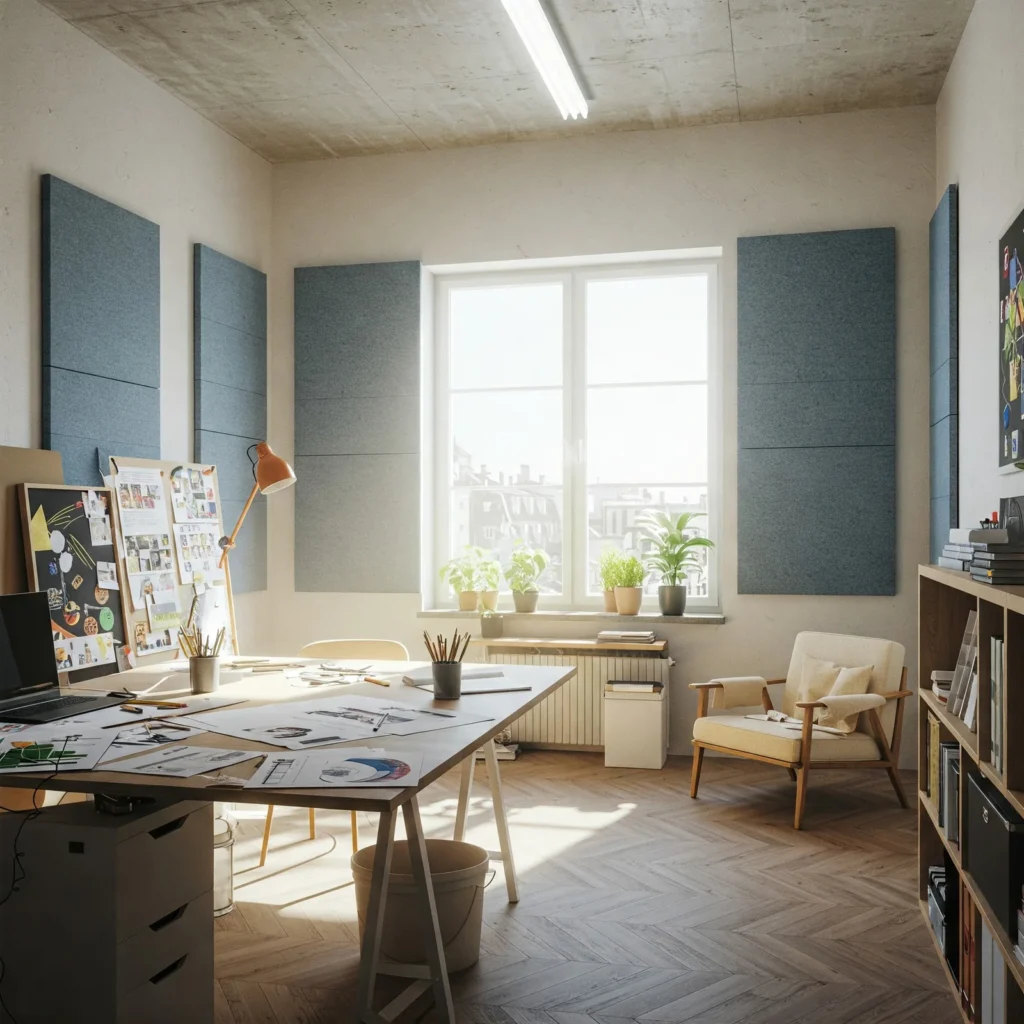
High ceilings can be extremely beautiful. On the one hand, they provide an impressive sense of scale and luxury, as well as breathing room. However, they’re a nightmare for the acoustics. If you’ve ever walked into the grand foyer of an ultra-modern gym or an office with a high ceiling and felt as if you were screaming into the abyss, you’ve witnessed an “echo chamber” effect. Sound waves move upwards through the ceiling and then reflect and create a tangled mess of sound.
We at SoundHaven Acoustics know that high ceilings require a specific treatment. It is not enough to simply put several thin squares of foam on the wall and hope to see a change. To effectively control the sound of these spaces, it is essential to know the mechanics of your space as well as the particular characteristics of the materials you’re employing.
In this article, we’ll guide you through the steps to select Acoustic wall panels for high ceilings, so that you can free your room from sounds while maintaining the beauty of your style.
Why High Ceilings Create Acoustic Challenges
Before we get into the process of selecting a space, it is important to know why your space sounds the way that it does. Sound behaves a bit like a rubber ball; when it strikes a hard surface (like the ceiling of drywall 20 feet high), it bounces. In rooms with high ceilings, sound travels longer from the point of origin to the ceiling before returning to the ceiling. This causes Reverberation.
If multiple sounds – footsteps, voices, or music move around at different times, the sounds are overlapping. This causes low speech clarity, in which you can hear somebody speaking but can’t understand the words. To remedy this issue, you must stop the audio waves prior to them turning into an issue.
1. Prioritize Thickness and Density
In deciding on the best acoustic wall panels to fit high ceilings, the thickness of the panel is your most reliable friend. For smaller rooms with standard ceilings of eight feet, 1-inch panels could be adequate for high-frequency flutter echoes. However, high-ceilinged rooms generally suffer from an accumulation of mid and low frequencies.
- 2-inch panels are the standard in high-performance rooms. The 2-inch thickness of the panel offers more absorption, and can soak up the deep, “boomy” sounds that are often throughout large spaces.
- Density is important: Choose panels that are filled with mineral wool with high density or Acoustic Fiberglass. At SoundHaven Acoustics, our professional-grade panels are built with high-density cores that actually absorb the sound instead of letting it through and bouncing off the walls behind them.
2. Calculate Your Coverage Area
The biggest errors individuals make are underestimating the number of panels they will require. A tall ceiling can add a huge volume of cubic space to an area.
A useful rule of thumb to follow for “problem” rooms with high ceilings is covering around 20%-30% of the wall area.
- Strategic Positioning: You don’t have to completely cover all the walls from ceilings to floors. Keep your focus at the “human level”-the region between approximately 3 to 7 feet from the floor. This is the place where the majority of sounds are generated (talking) and also where the sound is received (ears).
- The Third Upper: While humans are essential when it comes to rooms with high ceilings, the placement of several panels higher could assist in helping “catch” the sound before it reaches the ceiling, dramatically reducing the overall impact of reflections.
3. Consider the NRC Rating
If you’re searching for a “cheat code” on how to select acoustic wall panels to fit high ceilings, you need to know the NRC (Noise Reduction Coefficient). The rating varies from zero to 1.0.
- The NRC of 0 means that the panel is not able to absorb sound.
- The NRC of 1.0 is a sign that it absorbs all sound that enters it.
For high ceilings, look at panels with an NRC of 0.85 or greater. Since there is so much air to pass through, each panel you put in place must be twice as efficient. Selecting a panel with a good rating ensures that you receive the best “bang for your buck” in terms of noise suppression.
4. Don’t Forget About Aesthetics
We at SoundHaven Acoustics believe that a space should look as great as it sounds. The ceilings that are high usually belong to the most luxurious spaces, such as home theaters, luxury offices, or modern churches.
- Fabric Selection: Select acoustically transparent fabrics that complement your interior decor. From earthy neutral tones to vibrant gallery-style colors, your panels can be used as a feature of design rather than a utilitarian.
- Designs and Layouts: Tall walls provide a huge canvas. Instead of standard rectangles, look at staggered layouts or large-format panels that emphasize the size of the room while also treating it.
5. Make Corners more visible by using Bass Traps
If the room you are in feels “heavy” or “muddy,” we suggest using corner bass traps to help eliminate the low-end frequencies. The low-frequency energy naturally moves into 90-degree angles. To get the most out of your acoustics, add walls by using Corner Bass Traps.
Suppose you treat the vertical edges of your high walls to prevent the “boomy” resonance that often occurs in large open-concept spaces. This will result in a “tighter” and more professional sound pattern.
6. Synergy Between Walls and Ceilings
This guide is focused on the process of choosing Acoustic wall panels for tall ceilings. The best option is usually using a mix of approaches. When your walls are made of glass or have windows that are large (common in high-ceiling styles), you may only have a small amount of space for wall panels.
If you are considering this, think about using your wall panels in conjunction with Acoustic Clouds or Baffles that are hung straight from your ceiling. The main reflection point absorbs the sound and works in conjunction with the decor to form a “Sound Haven.”
Unique Insights: The “Human” Touch in Acoustic Design
When we talk to clients, we frequently inform them that acoustics are more of an art than it is a science. In rooms with large ceilings, the aim isn’t to make the space “dead” or silent–that can be uncomfortable and unnatural. The aim is to create clarity.
Consider your room as the instrument of a musician. You’ll want to hear the “notes” of a conversation or track to sound clear. When you choose the right thickness and arrange the panels so that sound travels, you can keep your “airy” feel of your high ceilings, while eliminating the noise and chaos that make the room uncomfortable.
Why Choose SoundHaven Acoustics?
We don’t sell just products; we offer solutions. Our panels are constructed within the U.S. with a focus on quality and durability. If you’re working with the challenges of acoustics with high ceilings, it is essential to choose materials designed to deliver real-world performance.
- Custom Solutions: Each high-ceilinged area is unique. If it’s a fitness center in Austin or an office in Georgetown, we can offer tailored guidance to ensure that your panels are suited to your particular dimensions.
- Installation is simple. Panels are easy to hang and make it simple to change your living space without the need for a huge construction project.
Final Thoughts
Knowing how to select the best acoustic wall panels to fit high ceilings is a first step towards a more efficient and serene space. By focusing on thickness, NRC ratings, and the right placement, it is possible to transform an echoing, noisy hall into a practical, luxurious space.
Don’t let your ceilings be a hindrance to you. Give your walls all the care they merit, then your home will “Hear The Difference” immediately.
Are you ready to change the look of your home? Take a look at our range of Acoustic Wall Panels or call our team now for an appointment to discuss your needs in detail. If you’re in your home office or commercial location, SoundHaven Acoustics has the experience to assist you in navigating your surroundings.